9th Class Physics New Book 2025 Chapter 2 Solved Exercise
9th Class Physics New Book 2025 Chapter 2 Solved Exercise
Class 9 Physics New Book 2025 Chapter 2 MCQs
2.1 The numerical ratio of displacement to distance is:
(a) always less than one (b) always equal to one (c) always greater than one (d) equal to or less than one
Option (d) is correct.
Explanation:-
Because displacement is the shortest distance so, distance will always be equal or greater than the displacement.
If motion is in straight line, ration between displacement and distance will be 1.
But, if displacement is less than distance, that is motion is curved, numerical ratio of displacement to distance will also be less than 1.
————————————————————————————————————————————————–
2.2 If a body does not change its position with respect to some fixed point, then it will be in a state of:
(a) rest (b) motion (c) uniform motion (d) variable motion
Option (a) is correct
Explanation:-
Rest means object is not changing its position with respect to its surroundings
————————————————————————————————————————————————–
2.3 A boll is dropped from the top of a tower, the distance covered by it in the first second is:
(a) 5 m (b) 10 m (C) 50 m (d) 100 m
Option ( a ) is correct.
Explanation:-
$$Initial\;velocity=v_i=\;0\\Acceleration=g=10\;ms^{-2}\\Time\;=\;t\;=\;1\;s\\Dis\tan ce\;=\;S\;=\;?$$
FORMULA:-
$$S\;=\;v_it\;+\frac12gt^2$$
$$S\;=(0)\;(1)+\frac12(10)\;{(1)}^2\\\\S\;=\;5\;m$$
————————————————————————————————————————————————–
2.4 A body accelerates from rest to a velocity of 144 Km in 20 second. The distance covered by it is:
(a) 100 m (b) 400 m (c) 1400 m (d) 1440 m
Option ( b ) is correct.
Explanation:-
$$Initial\;velocity=v_i=0\\\\Final\;velocity=v_f=144kmh^{-1}\\=144\;(\frac{1000}{3600})\;=\;40\;ms^{-1}\\\\Time\;=\;t\;=\;20\;s\\Dis\tan ce\;=\;S\;=\;?\\$$
FORMULA:-
$$S\;=\;V_{av}\;\times\;t\\\\S\;=\;(\frac{v_i\;+\;v_f}2)\;t\\$$
$$After\;putting\;the\;values\\We\;get\\\\S\;=\;(\frac{0\;+\;40}2)\;(\;20\;)\\S\;=\;400\;m\\$$
————————————————————————————————————————————————–
2.7 The area under the speed-time graph is numerically equal to:
(a) velocity (b) uniform velocity (c) acceleration (d) distance covered
Option ( d ) is correct.
Explanation:-
Because S = V t. Distance is equal to the product of speed and time.
9th Class Physics New Book 2025 Chapter 2 Short Questions
2.1 Define scalar and vector quantities.
Page 29
Scalar
A scalar is that physical quantity which needs magnitude only to describe it completely.
Vector
A vector is that physical quantity which needs magnitude as well as direction to describe it completely.
==========================================
2.2 Give 5 examples each for scalar and vector quantities.
Page 29
Examples of scalars are distance, speed, mass, time, temperature, and energy.
Examples of vector are displacement, velocity, acceleration, force, torque and momentum.
==========================================
2.3 State head-to-tail rule for addition of vector.
Page 31
To add vectors, we apply a rule called head-to-tail rule.
Definition of head to tail rule.
To add vectors, we draw their representative lines such that the head of one line coincides with the tail of the other. The resultant vector is given by a single vector which is directed from the tail of the first vector to the head of the last vector.
==========================================
2.4 What are distance-time graph and speed-time graph.
Page 39
Distance-time graph shows the relation between distance S and time t taken by a body.
We take time t along x-axis and distance s along y-axis
Gradient (slope) of distance-time graph gives us speed.
Page 42
Speed-time graph shows the relation between speed V and time t taken by a body.
We take time t along x-axis and speed v along y-axis
Gradient (slope) of speed-time graph gives us acceleration.
==========================================
2.5 Falling objects near the Earth have the same constant acceleration. Does this imply that a heavier object will fall faster than a lighter object?
No, heavier object will not fall faster than a lighter object in the absence of air resistance.
Weight of any body will not affect the rate of free fall.
$$g\;=\;9.8\;m\;s^{-2}\;\approx\;10\;m\;s^{-2}$$
==========================================
9th Class Physics New Book 2025 Chapter 2 Constructed Response Questions
2.2 When a bullet is fired, its velocity with which it leaves the barrel is called the muzzle velocity of the gun. The muzzle velocity of one gun with a longer barrel is lesser than that of another gun with a shorter barrel. In which gun is the acceleration of the bullet larger? Explain your answer.
$$v_f^2-v_i^2=2as\\Bullet\;starts\;from\;rest\\So,\;initial\;velocity\;will\;be\;0\\v_f^2-0=2as\\v_f^2=2as\\\frac{v_f^2}{2s}=a\\a=\frac{v_f^2}{2s}$$
The above relation shows that acceleration is inversely proportional to the distance. So, the shorter barrel gun will have the larger acceleration.
========================================
2.6 Is it possible that the velocity of an object is zero at an instant of time, but its acceleration is not zero? If yes, give an example of such a case.
Yes it is possible. When we throw a ball vertically upward its velocity will be zero at the highest point but its acceleration will not be zero at that instant. At that point its acceleration will be acceleration due to gravity i.e 9.8 meter per second square.
========================================
Class 9 Physics 2025 Chapter 2 Comprehensive Questions
2.1:- How a vector can be represented graphically? Explain
We represent a vector by an arrow head on it or below it or with a bold face letter.
$$\boldsymbol A\boldsymbol\;or\;\overrightarrow A\;or\;\underrightarrow A$$
We represent a vector graphically by drawing a line segment with an arrow head at its one end. The length of line segment represents the magnitude of vector quantity according to a suitable scale and the direction of arrow represents the direction of vector. First we draw a cartesian coordinate system. A vector is drawn starting from origin towards the given direction. The direction is usually given by an angle with the x-axis. The angle with the x-axis is measured from the right side of x-axis in anti-clockwise direction.
============
2.2:- Differentiate between rest and motion and speed and velocity.
Rest and Motion:-
Body is at rest, if a it does not change its position with respect to its surroundings.
Body is in motion, if it is continuously changing its position with respect to its surroundings.
The state of rest or motion of a body is always relative.
Speed and Velocity:-
Distance covered in unit time in known as speed. It is a scalar quantity.
Rate of change of displacement with respect to time is called velocity.
Both have unit meter per second.
============
2.4:- Explain the difference between distance and displacement.
The net displacement of a body in unit time is called velocity. It is a vector quantity.
If a body moves from a point A to a point B along a curved path, the displacement d is the straight line AB.
The direction of velocity is the same as the direction of displacement. It SI unit is also meter per second
============
2.6:- Prove that the area under speed-time graph is equal to the distance covered by an object.
An object is moving with constant speed v. For a time interval t, the distance s covered by the object will vt.
The area under the graph for time interval t is the area of rectangles of sides t and v. This area is equal to v multiplied by t. So, the area under the speed-time graph up to time axis is numerically equal to the distance covered by the object in time t.
If speed increases uniformly from 0 to v in time interval t, area under the speed time graph is a triangle. Distance covered is equal to area under the graph.
Distance = 1/2 (height) (base) = 1/2 vt
if the speed increases uniformly from 0 to v in time interval t, distance covered is 1/2 vt, which is equal to area under the speed-time graph.
Class 9 Physics New Book 2025 Chapter 2 Numerical
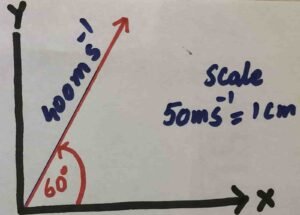
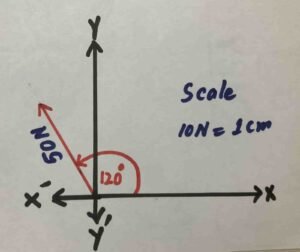
2.1 Draw the representative lines of the following vectors
(a) A velocity of 400 meters per second making an angle of 60 degree with the x-axis
(b) A force of 50 N making an angle of 120 degree with x-axis
———–
2.2 A car is moving with an average speed of 72 kilometre per hour. How much time will it take to cover a distance of 360 km ?
$$\mathit\;v_{av}\mathit=\mathit\;\mathit{72}\mathit\;km\mathit\;h^{\mathit-\mathit1}\\\mathit\;S\mathit\;\mathit=\mathit\;\mathit{360}\mathit\;km\\\mathit\;t\mathit\;\mathit=\mathit\;\mathit?\\\\\;S\;=\;v_{av}\;\times\;t\\\mathit{360}\mathit\;\mathit\;\mathit=\mathit\;\mathit{72}\mathit\;\mathit\;\mathit\times\mathit\;t\\\mathit5\mathit\;h\mathit\;\mathit=\mathit\;t\\t\mathit\;\mathit=\mathit\;\mathit5\mathit\;h\\$$
t = 5 x 60 = 300 min =300 x 60 s = 18000 s
———–
2.3 A truck starts from rest. It reaches a velocity of 90 kilometre per hour in 50 seconds. Find its average acceleration.
$$v_i\mathit=\mathit0\mathit\;m\mathit\;s^{\mathit-\mathit1}\\v_f\mathit=\mathit{90}\mathit\;km\mathit\;h^{\mathit-\mathit1}\\\mathit=\mathit\;\mathit{90}\mathit\;\mathit\times\mathit\;\frac{\mathit{1000}}{\mathit{3600}}\mathit\;m\mathit\;s^{\mathit-\mathit1}\mathit\;\\\mathit=\mathit\;\mathit{90}\mathit\;\mathit\times\mathit\;\mathit0\mathit.\mathit{277}\mathit\;m\mathit\;s^{\mathit-\mathit1}\mathit\;\\\mathit=\mathit\;\mathit{24}\mathit.\mathit{93}\mathit\;m\mathit\;s^{\mathit-\mathit1}\mathit\;\\\mathit\;t\mathit\;\mathit=\mathit\;\mathit{50}\mathit\;s\\\mathit=a_{av}\mathit=\mathit?\\\\a_{av}\mathit\;\mathit=\mathit\;\mathit\;\frac{v_f\mathit\;\mathit-\mathit\;v_i}t\\a_{av}\mathit\;\mathit=\mathit\;\mathit\;\frac{\mathit\;\mathit{24}\mathit.\mathit{93}\mathit-\mathit\;\mathit0\mathit\;}{\mathit{50}\mathit\;}\\\\a_{av}\mathit\;\mathit=\mathit\;\mathit\;\frac{\mathit\;\mathit{24}\mathit.\mathit{93}\mathit\;}{\mathit{50}\mathit\;}\\\\a_{av}\mathit\;\mathit=\mathit\;\mathit0\mathit.\mathit5\mathit\;m\mathit\;s^{\mathit-\mathit2}$$
———–
2.4 A car passes a green traffic signal while moving with a velocity of 5 metre per second. It then accelerates 1.5 meter per second square. What is the velocity of the car after 5 seconds ?
$$\mathit\;v_i\mathit\;\mathit=\mathit\;\mathit5\mathit\;m\mathit\;s^{\mathit-\mathit1}\\\mathit\;a\mathit\;\mathit=\mathit\;\mathit1\mathit.\mathit5\mathit\;m\mathit\;s^{\mathit-\mathit2}\\\mathit\;t\mathit\;\mathit=\mathit\;\mathit5\mathit\;seconds\\v_f\mathit\;\mathit=\mathit\;\mathit?\\\\v_f\;=\;v_i\;+\;at\\v_f\mathit=\mathit\;\mathit\;\mathit5\mathit\;\mathit+\mathit\;\mathit1\mathit.\mathit5\mathit\;\mathit\;\mathit(\mathit5\mathit\;\mathit)\\v_f\mathit=\mathit\;\mathit{12}\mathit.\mathit5\mathit\;m\mathit\;s^{\mathit-\mathit1}\mathit\;$$
———–
2.6 A wagon is moving on a road with a velocity of 54 kilometre per hour. Brakes are applied suddenly. The wagon covers a distance of 25 m before stopping. Determine the acceleration of the wagon.
$$v_i\mathit=\mathit{54}\mathit\;km\mathit\;h^{\mathit-\mathit1}\\\mathit=\mathit\;\mathit{54}\mathit\;\mathit\times\mathit\;\frac{\mathit{1000}}{\mathit{3600}}\mathit\;m\mathit\;s^{\mathit-\mathit1}\\\mathit\;\mathit=\mathit\;\mathit{54}\mathit\;\mathit\times\mathit\;\mathit0\mathit.\mathit{278}\mathit\;m\mathit\;s^{\mathit-\mathit1}\\\\\mathit=\mathit\;\mathit{15}\mathit.\mathit{012}\mathit\;m\mathit\;s^{\mathit-\mathit1}\\\\v_f\mathit=\mathit0\mathit\;ms^{\mathit-\mathit1}\\\mathit\;S\mathit\;\mathit=\mathit\;\mathit{25}\mathit\;m\\\mathit\;a\mathit\;\mathit=\mathit\;\mathit?\\\\\mathit2aS\mathit\;\mathit=\mathit\;v_f^{\mathit2}\mathit\;\mathit-\mathit\;v_i^{\mathit2}\\\mathit2a\mathit(\mathit{25}\mathit)\mathit=\mathit0^{\mathit2}\mathit-{\mathit(\mathit{15}\mathit.\mathit{012}\mathit\;\mathit)}^{\mathit2}\\a\mathit\;\mathit=\mathit\;\mathit-\mathit4\mathit.\mathit{507}\mathit\;m\mathit\;s^{\mathit-\mathit2}$$
———–
2.7 A stone is dropped from a height of 45 m. How long will it take to reach the ground ? What will be its velocity just before hitting the ground ?
$$h\;=\;45\;m\\\;v_i=\;0\;ms^{-1}\\g=9.8ms^{-2}\\\;t\;=\;?\\v_f\;=\;?\\$$
$$h=v_it\;+\;\frac12gt^2\\45=0(t)\;+\frac12(10)\;t^2\\\frac{45}5\;=\;t^2\\t^2\;=\;9\;\\t\;=\;3s\\$$
$$v_f\;=\;v_i\;+\;a\;t\\v_f\;=\;0\;+(10)\;(\;3\;)\\v_f\;=\;30\;m\;s^{-1}\\$$
———–
2.9 A ball is dropped from the top of a tower. The ball reaches the ground in 5 s. Find the height of the tower and the velocity of the ball with which it strikes the ground.
$$t\mathit=\mathit\;\mathit5\mathit\;seconds\\v_i\mathit\;\mathit=\mathit\;\mathit0\mathit\;m\mathit\;s^{\mathit-\mathit1}\\\mathit\;g\mathit=\mathit{10}\mathit\;ms^{\mathit-\mathit2}\\h\mathit\;\mathit=\mathit\;\mathit?\\\mathit\;v_f\mathit\;\mathit=\mathit\;\mathit?\\h\mathit\;\mathit=\mathit\;v_i\mathit\;t\mathit\;\mathit+\mathit\;\frac{\mathit1}{\mathit2}\mathit\;g\mathit\;t^{\mathit2}\\h\mathit\;\mathit=\mathit(\mathit0\mathit\;\mathit)\mathit\;\mathit(\mathit5\mathit\;\mathit)\mathit+\frac{\mathit1}{\mathit2}\mathit(\mathit{10}\mathit\;\mathit)\mathit\;{\mathit(\mathit5\mathit\;\mathit)}^{\mathit2}\\h\mathit\;\mathit=\mathit\;\mathit\;\mathit{125}\mathit\;m\\\\v_f\mathit\;\mathit=\mathit\;v_i\mathit\;\mathit+\mathit\;g\mathit\;t\\v_f\mathit\;\mathit=\mathit\;\mathit0\mathit\;\mathit+\mathit(\mathit\;\mathit{10}\mathit\;\mathit)\mathit\;\mathit(\mathit5\mathit\;\mathit)\\v_f\mathit\;\mathit=\mathit\;\mathit{50}\mathit\;m\mathit\;s^{\mathit-\mathit1}$$
====================================================================================
We give some useful links below