Math Class 9 New Book Exercise 1.1
Math Class 9 New Book Exercise 1.1.we will solve all exercises of first chapter of new syllabus developed by the government of the Punjab. we will try our best to give you written as well as visual solution. Here we will differentiate between rational and irrational numbers, properties equality and inequality of real numbers and how to insert rational numbers between two real numbers. In this post, you will see different types of solution of Math Class 9 New Book Exercise 1.1. We will provide video of each question, written material and notes also of Math Class 9 New Book Exercise 1.1. you will see all the concepts of Math Class 9 New Book Exercise 1.1.
We will start from definition of set, different types of sets such as set of natural numbers, set or rational number and set of real numbers. You will also see the solved examples of Math Class 9 New Book Exercise 1.1 in full detail.
=========================
To download Math Class 9 New Book Exercise 1.1 Solved Examples click on the following link.
Math Class 9 New Book Exercise 1.1 Examples
=========================
In this post you will see detail related to additive properties of real numbers, multiplicative properties of real numbers and distributive properties of real numbers. We will also give the concept of properties of equality of real numbers. We will also deal with trichotomy property, transitive property, additive property, division property and reciprocal property. Right and left distributive laws will also be discussed
Q1:- Identify each of the following as rational or irrational number.
$$(i)\;\;2.353535\;\;Rational\\\\(ii)\;\;0.\overline6\;\;\;Rational\\\\(iii)\;\;2.636067….\;\;\;Irrational\\\\(iv)\;\;\sqrt7\;\;Irrational\\\\(v)\;\;e\;\;\;Irrational\\\\(vi)\;\;\mathrm\pi\;\;\mathrm{Irrational}\\\\(\mathrm{vii})\;\;5+\sqrt{11}\;\mathrm{Irrational}\\\\(\mathrm{viii})\;\sqrt3+\sqrt{13}\;\mathrm{Irrational}\\\\(\mathrm{ix})\;\;\frac{15}4\;\;\mathrm{Rational}\\\\(\mathrm x)\;\;(2-\sqrt2)\;(2+\sqrt2)\;=\;{(2)}^2\;-{(\sqrt2)}^2\\\;=4-2\;=\;2\;\;\;\mathrm{Rational}$$
————————————————————————————————————————————————–
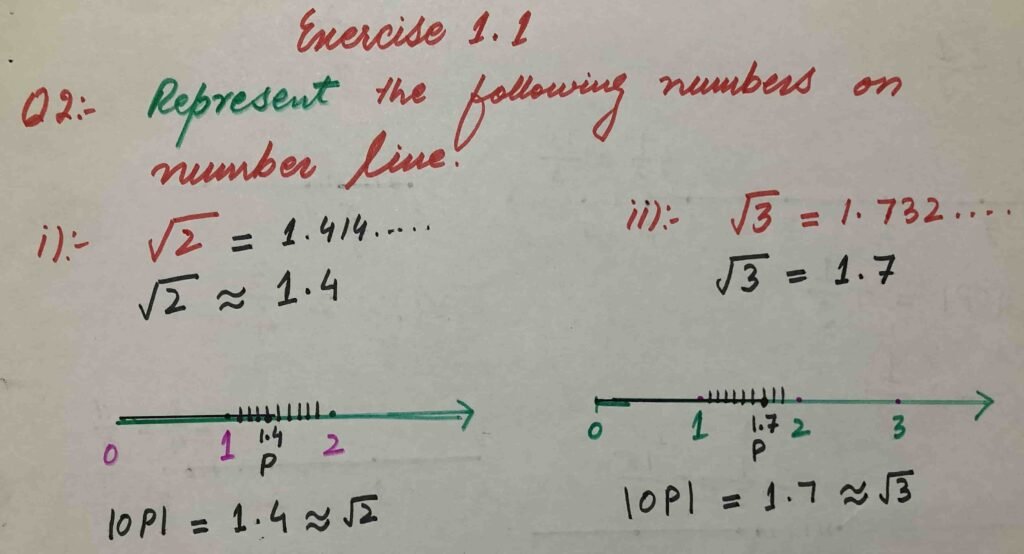
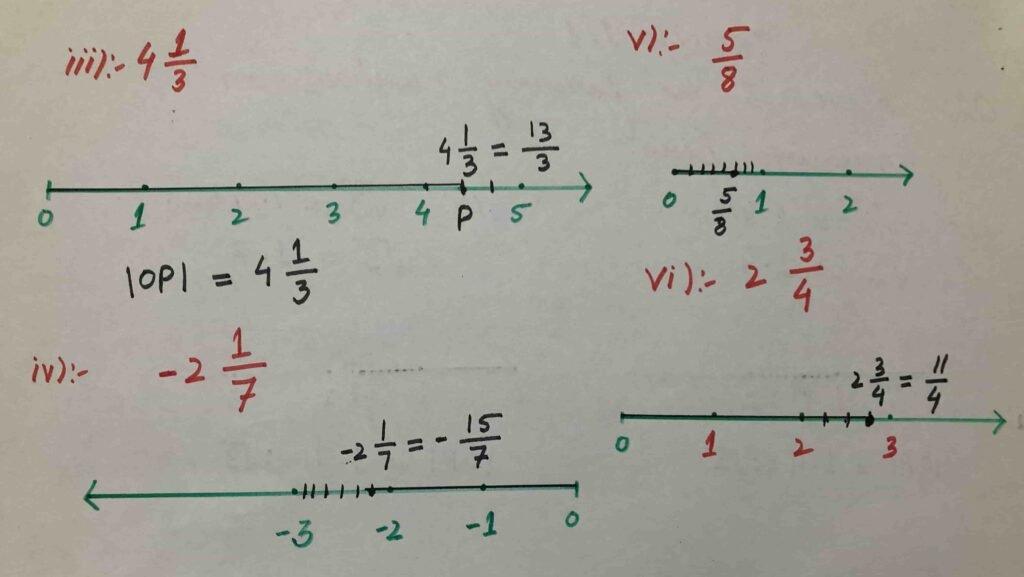
Q2:- Represent the following numbers on number line.
$$(i)\;\sqrt2\;\;\;\;(ii)\;\sqrt3\;\;\;\;(iii)\;4\frac13\;\;\\\\\;(iv)\;-2\frac17\;\;\;(v)\;\frac58\;\;\;(vi)\;\;2\frac34$$
————————————————————————————————————————————————–
Q3:- Express the following as rational numbers p/q where p and q are integers and q is not equal to zero.
$$(i)\;\;0\overline{.4}\\\\Let\;\;x\;=\;0\overline{.4}\\\\x=0.44444……\\\\Multiplying\;both\;the\;sides\;by\;10\\\\10x\;=\;4.44444……\\\\Subtracting\;x\;on\;both\;the\;sides\\\\10x-x\;=\;4.44444……\;-\;x\\\\9x\;=\;4.44444………\;-\;0.44444……..\\\\9x\;=\;4\\\\x=\frac49$$
$$(ii)\;\;0\overline{.37}\\\\Let\;\;x\;=\;0\overline{.37}\\\\x=0.373737……\\\\Multiplying\;both\;the\;sides\;by\;100\\\\100x\;=\;37.373737……\\\\Subtracting\;x\;on\;both\;the\;sides\\\\100x-x\;=\;37.373737……\;-\;x\\\\99x\;=\;37.373737………\;-\;0.373737……..\\\\99x\;=\;37\\\\x=\frac{37}{99}$$
$$(ii)\;\;0\overline{.21}\\\\Let\;\;x\;=\;0\overline{.21}\\\\x=0.212121……\\\\Multiplying\;both\;the\;sides\;by\;100\\\\100x\;=\;21.212121……\\\\Subtracting\;x\;on\;both\;the\;sides\\\\100x-x\;=\;21.212121……\;-\;x\\\\99x\;=\;21.212121………\;-\;0.212121……..\\\\99x\;=\;21\\\\x=\frac{21}{99}$$
————————————————————————————————————————————————–
Q4:- Name the property used in the following.
(i) (a+4) +b = a+(4+b)
Associative law of addition
————————————————————————-
(ii) Square root 2 + square root 3 = square root 3 + square root 2
Commutative law with respect to addition
————————————————————————-
(iii) x-x =0
Additive inverse
————————————————————————-
(iv) a( b + c ) = ab + ac
Left distributive law of multiplication over addition
————————————————————————-
(v) 16+0=16
Additive identity
————————————————————————-
(vi) 100×1=100
Multiplicative identity
————————————————————————-
(vii) 4 x ( 5 x 8 ) = ( 4 x 5 ) x 8
Associative law of multiplication
————————————————————————-
(viii) a b = b a
Commutative law with respect to multiplication
————————————————————————————————————————————————–
Q5:- Name the property used in the following.
$$(i)\;\;-3<-1\;\;\Rightarrow\;0<2\\\\\boldsymbol A\boldsymbol d\boldsymbol d\boldsymbol i\boldsymbol t\boldsymbol i\boldsymbol v\boldsymbol e\boldsymbol\;\boldsymbol p\boldsymbol r\boldsymbol o\boldsymbol p\boldsymbol e\boldsymbol r\boldsymbol t\boldsymbol y\\\\(ii)\;\;If\;a<b\;\;then\;\frac1a\;>\;\frac1b\\\\\boldsymbol R\boldsymbol e\boldsymbol c\boldsymbol i\boldsymbol p\boldsymbol r\boldsymbol o\boldsymbol c\boldsymbol a\boldsymbol l\boldsymbol\;\boldsymbol p\boldsymbol r\boldsymbol o\boldsymbol p\boldsymbol e\boldsymbol r\boldsymbol t\boldsymbol y\\\\(iii)\;\;\;If\;a<b\;\;then\;a\;+\;c\;<\;b\;+\;c\\\\\boldsymbol A\boldsymbol d\boldsymbol d\boldsymbol i\boldsymbol t\boldsymbol i\boldsymbol v\boldsymbol e\boldsymbol\;\boldsymbol p\boldsymbol r\boldsymbol o\boldsymbol p\boldsymbol e\boldsymbol r\boldsymbol t\boldsymbol y\\\\(iv)\;\;\;If\;ac<bc\;\;and\;c>0\;then\;a<b\\\\\boldsymbol D\boldsymbol i\boldsymbol v\boldsymbol i\boldsymbol s\boldsymbol i\boldsymbol o\boldsymbol n\boldsymbol\;\boldsymbol p\boldsymbol r\boldsymbol o\boldsymbol p\boldsymbol e\boldsymbol r\boldsymbol t\boldsymbol y\\\\(v)\;\;\;If\;ac<bc\;\;and\;c\;<\;0\;then\;a>b\\\\\boldsymbol D\boldsymbol i\boldsymbol v\boldsymbol i\boldsymbol s\boldsymbol i\boldsymbol o\boldsymbol n\boldsymbol\;\boldsymbol p\boldsymbol r\boldsymbol o\boldsymbol p\boldsymbol e\boldsymbol r\boldsymbol t\boldsymbol y\\\\(vi)\;\;Either\;\;a>b\;\;or\;a=b\;\;or\;a<b\\\\\boldsymbol T\boldsymbol r\boldsymbol i\boldsymbol c\boldsymbol h\boldsymbol o\boldsymbol t\boldsymbol o\boldsymbol m\boldsymbol y\boldsymbol\;\boldsymbol p\boldsymbol r\boldsymbol o\boldsymbol p\boldsymbol e\boldsymbol r\boldsymbol t\boldsymbol y$$
————————————————————————————————————————————————–
Q6:- Insert two rational numbers between (i) 1/3 and 1/4 (ii) 3 and 4 (iii) 3/5 and 4/5
$$(i)\;\;\frac13\;and\;\frac14\\Average\;of\;\;\frac13\;and\;\frac14=\;\frac{{\displaystyle\frac13}\;+\;{\displaystyle\frac14}}2=\frac{\displaystyle\frac{4+3}{12}}2=\frac7{24}\\\\Average\;of\;\;\frac7{24}\;and\;\frac14=\;\frac{\displaystyle\frac7{24}\;+\;\frac14}2=\frac{\displaystyle\frac{7+6}{24}}2=\frac{13}{48}\\\\Hence\;inserted\;rational\;numbers\;are\;\frac7{24}\;and\;\frac{13}{48}$$
————————————————————————-
$$(ii)\;\;3\;and\;4\\\\Average\;of\;3\;and\;4\;=\;\frac{3+4}2\;=\;\frac72\\\\Avarage\;of\;\frac72\;and\;4\;=\;\frac{{\displaystyle\frac72}\;+4}2\;=\;\frac{\displaystyle\frac{7+8}2}2\;=\;\frac{15}4$$
————————————————————————-
$$(iii)\;\;\frac35\;and\;\frac45\\Average\;of\;\;\;\frac35\;and\;\frac45=\;\frac{{\displaystyle\frac35}\;+\;{\displaystyle\frac45}}2=\frac{\displaystyle\frac{3+4}5}2=\frac7{10}\\\\Average\;of\;\;\;\frac7{10}\;and\;\frac45=\;\frac{\displaystyle\frac7{10}\;+\;\frac45}2=\frac{\displaystyle\frac{7+8}{10}}2=\frac{15}{20}\\\\Hence\;inserted\;rational\;numbers\;are\;\frac7{10}\;and\;\frac{15}{20}$$
————————————————————————————————————————————————–
Best of luck for your bright future. Remember me in your prayers. Check! some useful links.
————————————————————————————————————————————————–